
Tips for Building a Profitable Piggery Business
 Running a piggery business successfully takes more than keeping pigs alive and selling them when they are big enough. If you want your farm to remain productive and financially rewarding, you need to treat it like a real business. That means paying attention not only to animal care, but also to the choices that affect cost, efficiency, output, and long-term growth. Many pig farmers work very hard every day and still struggle to see strong financial results because profit is being lost in ways that are not always obvious.
A profitable piggery business is built through control, discipline, and good decision-making. You need to understand where your money is going, what areas of the farm are performing well, and where losses are eating into your returns. When you learn to manage your farm with profit in mind, you begin to see that success does not come only from producing more pigs. It comes from producing and managing them in a way that gives you better value from the resources you are already using.
Profit in pig farming starts with understanding your numbers
One of the biggest mistakes pig farmers make is assuming the business is profitable simply because pigs are being sold and money is coming in. Sales alone do not tell you whether the farm is truly making progress. What matters is how much you are spending to produce those pigs and how much remains after those costs are covered. If you do not understand your numbers clearly, it becomes very easy to overestimate success while the business quietly loses strength.
To build a profitable piggery business, you need to know your major production costs. Feed is often the largest expense, but it is not the only one. Medication, labor, breeding costs, housing, water, electricity, transportation, repairs, and pig losses all affect your final result. If these costs are not tracked properly, you may not realize how much they are reducing your margins.
When you understand your numbers, you can begin to ask better questions. Are your feed costs too high for the weight gain you are getting? Are health issues increasing your expenses more than expected? Are some groups of pigs performing better than others? Are preventable losses damaging your results? These questions are what help you move from simply working hard to managing the farm in a more profitable way.
Feed management has a direct effect on your profit
Feed plays a central role in pig production, and it also has one of the biggest effects on profitability. If feed is poorly managed, profits can disappear quickly even when other parts of the farm seem to be going well. Wasted feed, poor-quality feed, wrong feeding schedules, or low feed efficiency all increase the cost of production and reduce the value you get from each pig.
Good feed management is not only about giving pigs enough to eat. It is about making sure the feed program matches the growth stage, condition, and production goal of the animals. If young pigs do not receive the nutrition they need early enough, growth can be delayed. If finishing pigs are fed inefficiently, you may spend more without getting the expected return in body weight. If feed storage is poor, spoilage and contamination can add losses that are easy to overlook.
When you monitor feed use carefully and compare it with pig performance, you gain a clearer understanding of whether your feeding program is supporting profit or quietly weakening it. Profitability improves when pigs convert feed efficiently, waste is controlled, and you are able to see which feeding decisions truly deliver results.
Healthy pigs protect your income
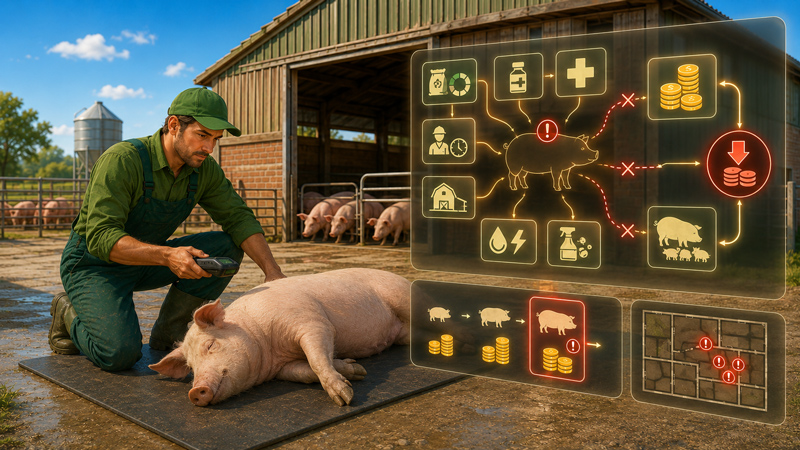
Disease and poor health are some of the fastest ways to reduce profitability on a pig farm. A sick pig does not grow well, may need treatment, may consume feed less efficiently, and may spread illness to others. In more serious cases, disease can lead to death, which means you lose both the pig and the money already invested in raising it. That is why protecting pig health is not only a welfare issue. It is a financial issue as well.
Many of the costs linked to health problems are not immediately visible. You may see the expense of medication, but not always the lost growth, delayed marketing, poor feed conversion, and labor time that come with repeated illness. When health problems become common, they affect the entire rhythm of the farm and make performance more difficult to control.
A profitable piggery business depends on preventing avoidable health losses wherever possible. This means paying attention to hygiene, housing conditions, vaccination programs, early treatment, and close observation of pigs. It also means keeping proper records so that recurring problems can be identified instead of treated as random events. Healthy pigs are more productive, more efficient, and more likely to deliver the return your farm depends on.
Reproductive efficiency influences business performance
Breeding and farrowing efficiency have a direct effect on how profitable your piggery business can become. The more effectively your sows conceive, carry pregnancies, farrow well, and raise viable piglets, the stronger your production base becomes. If reproductive performance is weak, the farm may struggle to produce enough healthy piglets to support growth and sales targets.
Poor conception rates, repeat breeding, low farrowing rates, stillbirths, and high piglet mortality all reduce the number of pigs available for the next stage of production. These losses affect profit long before a pig reaches market weight. When too many pigs are lost early, the cost of maintaining breeding animals becomes harder to recover, and overall output declines.
Improving reproductive efficiency helps create a more stable and profitable flow through the farm. It gives you more pigs to work with, better use of breeding stock, and stronger control over production planning. This is why profitable pig farming is not only about finishing pigs well. It begins much earlier, with how effectively the farm manages breeding and farrowing from the start.
Good records make better financial decisions possible
Many pig farmers know their farm closely from daily experience, but experience alone is not always enough to make strong business decisions. When records are weak or incomplete, it becomes difficult to measure what is truly helping the business and what is causing losses. You may feel that one area is underperforming, but without proper records, it is hard to compare batches, evaluate changes, or identify recurring patterns.
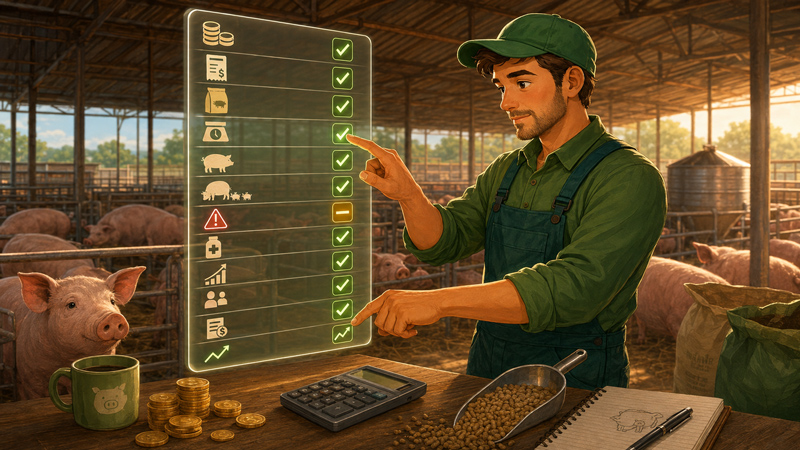
Good recordkeeping gives you a clearer picture of production and financial performance. You can track expenses, monitor health costs, compare feed use, review breeding outcomes, follow mortality patterns, and identify which groups of pigs are performing best. This turns your farm into something you can evaluate with more accuracy instead of relying only on memory or rough estimates.
Records also help you make decisions with more confidence. You can see whether an investment is improving performance, whether a repeated problem is draining money, and whether expansion makes sense based on actual output. This matters because many business mistakes happen when decisions are made too quickly or without enough evidence. A profitable piggery business grows more safely when decisions are supported by real data.
Common mistakes that weaken piggery profits
Some of the biggest threats to profit are not dramatic disasters but repeated management mistakes that slowly reduce efficiency. One common mistake is expanding too quickly. A farmer may want to increase herd size before the current system is fully under control, which can lead to overcrowding, more disease pressure, higher costs, and weaker performance across the farm. Growth without structure often creates more problems than profit.
Another common mistake is failing to separate business money from personal spending. When farm income is mixed with personal expenses, it becomes harder to understand whether the piggery is truly making money or simply generating cash flow. This confusion makes planning more difficult and often leads to poor decisions about reinvestment, pricing, and day-to-day spending.
Poor pricing decisions can also damage profitability. If you do not know your cost of production, it is difficult to judge whether a sale price is truly favorable. Some farmers sell quickly because they need cash, only to realize later that the pigs were sold below a level that supports real profit. Others hold pigs too long and spend more on feed without gaining enough added value.
Weak planning, poor recordkeeping, inconsistent care, and delayed response to problems all contribute to financial underperformance. The business may keep moving, but it becomes less efficient and less stable over time. Recognizing these mistakes early is one of the best ways to protect the farm’s future.
Better systems create a stronger business
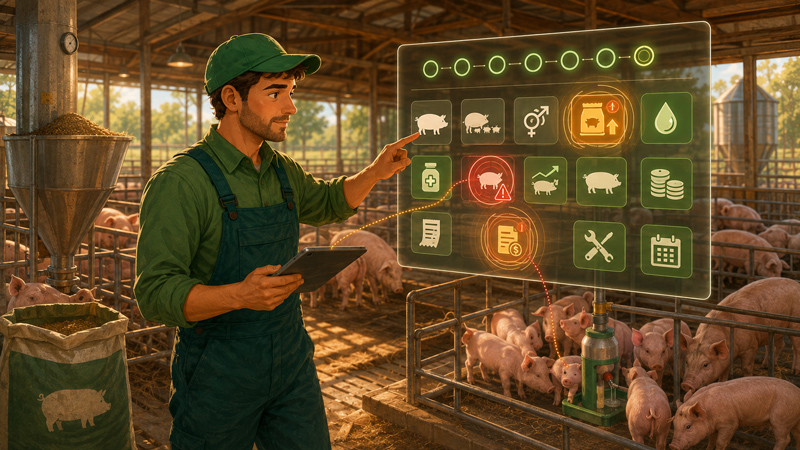
A profitable piggery business depends on having systems that support consistency. You need a reliable way to manage animal records, monitor health events, track breeding activity, review growth performance, and keep an eye on the costs that shape your margins. Without systems, you may still work hard, but too much depends on memory, urgency, and reaction instead of structure.
Strong systems help you notice problems faster and manage the farm more efficiently. You can prepare for breeding events, follow farrowing schedules, monitor feed use, review pig performance, and keep production records organized. This makes the business easier to control and reduces the chance that important details will be missed.
Using the right management tools also supports better planning. When information is easier to access and review, you are in a stronger position to decide when to expand, where to cut losses, and which practices are delivering the best value. Better systems do not replace practical farming experience. They strengthen it by helping you use information more effectively.
Sustainable growth matters more than fast growth
Many farmers dream of expanding quickly, but fast growth does not always lead to strong business results. A piggery business becomes more profitable when growth is supported by stable management, healthy pigs, controlled costs, and clear records. If you scale too early, you may simply multiply existing problems and place more pressure on the farm than it can handle.
Sustainable growth means improving what you already have before pushing for bigger numbers. It means strengthening health management, refining breeding results, improving feed efficiency, reducing avoidable losses, and building better recordkeeping habits. When these foundations are in place, expansion becomes safer and more likely to succeed.
A profitable business is not built in a hurry. It is built by making good decisions consistently over time. The farmers who achieve long-term success are often the ones who pay close attention to efficiency, learn from their records, and manage growth with patience and discipline.
Profit comes from better management, not just more pigs
If you want to build a profitable piggery business, you need to look beyond daily activity and focus on how the farm is performing as a business. Profit does not come automatically from hard work alone. It comes from controlling costs, improving efficiency, protecting pig health, strengthening reproductive performance, and making decisions based on clear information.
The good news is that profitability is something you can improve. When you begin to understand your numbers, use better systems, and pay close attention to the factors that shape farm performance, you put yourself in a stronger position to grow a piggery business that is not only active, but truly rewarding.