
Pig Farming Has a Global Market. Profit Starts With Knowing Your Costs.
Selling more pigs can grow your revenue while leaving you with less money.
That happens when feed use, mortality, labour and housing costs rise faster than the value of the animals sold. A busy farm can look successful while its margins quietly disappear.
Pig farming offers commercial opportunities across many markets. Turning those opportunities into a durable business requires a clear understanding of what each production cycle costs—and what buyers will actually pay.
A large market does not guarantee a profitable farm
Pork is a major international agricultural business. USDA’s October 2026 outlook forecasts global pork production of approximately 119.9 million tonnes in 2027, with exports of around 10.6 million tonnes. It anticipates production growth in Brazil, Vietnam and the United States, alongside declines in China and the European Union. apps.fas.usda.gov
That is a substantial market, but conditions differ between countries and producers. FAO’s October 2026 assessment reported falling international pig meat prices, with abundant European supplies and limited export opportunities weighing on quotations. fao.org
The practical lesson is to investigate your own market before expanding. Identify buyers, preferred weights, quality requirements, transport costs and payment terms. Check whether an apparent premium is genuinely available to your business.
Global demand creates possibilities. Your local selling price and production costs determine whether those possibilities are profitable.
What a French farm reveals about the margin
A Pig Progress farm visit to Mathieu Le Nouvel’s La Butte Rouge farm in Brittany provides a useful example of investment supported by attention to production economics.
At the September 2026 visit, the article reported a pig price of €1.90/kg, an additional €0.15/kg in premiums and a stated cost price of €1.70/kg. Food & Agribusiness
Using those figures on the same reported weight basis gives an illustrative spread of €0.35/kg. Without the premium, it would be €0.20/kg. This calculation is based on the reported figures; it is not an independently audited net-profit figure or a benchmark for other farms.
The important point is the relationship between income and cost. A favourable selling price becomes meaningful when the farmer knows the cost beneath it.
Better facilities must earn their place in the business
The same farm invested in new farrowing accommodation and cooling. The article reports heavier litters at weaning following the changes, but the project involved several improvements; it does not isolate the effect of one piece of equipment.
Le Nouvel describes his investment outlook simply:
“With an investment, you look ahead.”
He also highlights a practical production priority:
“Cooling is crucial with free-range farrowing pens.” Food & Agribusiness
For another farmer, the right investment may be different. Before committing money, define the problem, the expected improvement and the ongoing costs.
Will an upgrade reduce losses? Improve growth? Save labour? What will electricity, maintenance and finance add to the bill? Can the farm service the investment if selling prices weaken?
A capital purchase needs a business case that extends beyond a good month in the market.
Control costs by measuring efficiency
Cost control requires more thought than choosing the cheapest input.
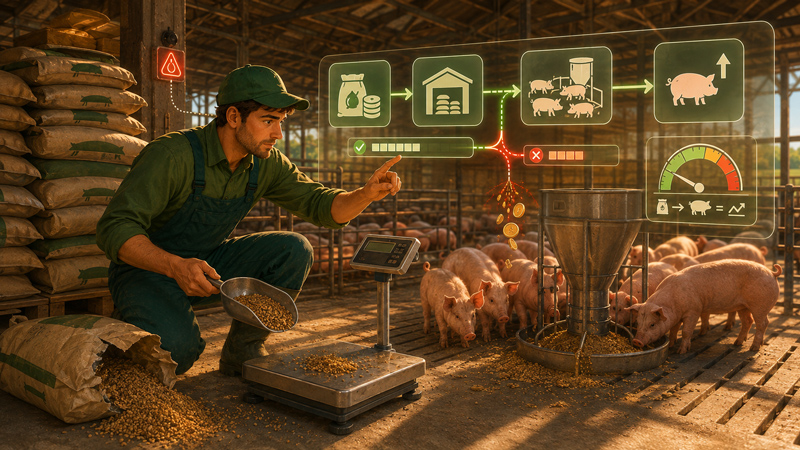
A cheaper ration may be poor value if growth slows or feed conversion deteriorates. Cutting maintenance can create larger repair costs later. Reducing essential health expenditure can expose the herd to avoidable losses.
Assess spending against the productive result it supports. Useful measures include:
- Feed used per kilogram of weight gain.
- Piglets weaned per sow.
- Mortality by production stage.
- Production cost per kilogram sold.
- Revenue and margin across comparable production cycles.
Keep weight bases consistent: liveweight prices and carcass-weight prices cannot be compared directly. Match production costs and output to the same group or cycle wherever possible.
How Pigax helps farmers manage the numbers
Pigax helps organise the records needed to investigate costs and performance. Its value depends on keeping those records accurate and current.
Track feed purchases, usage and stock
Pigax’s feed inventory records purchases, recorded usage and remaining stock. It also displays feed cost per kilogram based on purchase information. Pigax Documentation
This gives farmers a clearer foundation for purchasing and budgeting. Comparing recorded stock with physical stock can help identify discrepancies that need investigation, including missing entries or possible wastage.
Feed purchased and feed consumed are different measures. A large delivery can increase cash spending before all that feed has been used.
Keep operating expenses visible
Pigax supports recording income and expenses, including feed, medication and labour. Maintaining these records makes it easier to review where money is going and question changes in spending. Pigax Documentation
A complete business assessment should also account for costs that are easy to overlook, such as owner labour, depreciation, financing and unsold stock. Recording cash movements alone does not establish a fully costed profit figure.
Review production alongside spending
Pigax supports breeding, pregnancy, litter, weight, health and mortality records. These provide context for financial reviews. Pigax Documentation
If costs rise, investigate what happened in production. Were fewer animals sold? Did growth slow? Were there more losses or treatments?
The records help frame the investigation; they do not automatically establish the cause.
Make regular review part of management
Pigax provides downloadable reports covering farm activities and financial records. Use them to support a consistent review with the people responsible for feeding, animal care and purchasing. Pigax Documentation
Choose one issue to investigate, make a justified change and follow the results. Regular review is more useful than collecting months of information without acting on it.
Know your margin before you expand
Before adding more pigs, establish whether your current production is making an adequate return. Review actual selling prices, feed consumption, losses and operating costs, then allow for a less favourable market.
Expansion can multiply an efficient operation. It can also multiply an expensive problem.
Start by bringing your feed usage, expenses, sales and production records up to date in Pigax. Use that evidence to identify where your margin is being earned—and where it is being lost.