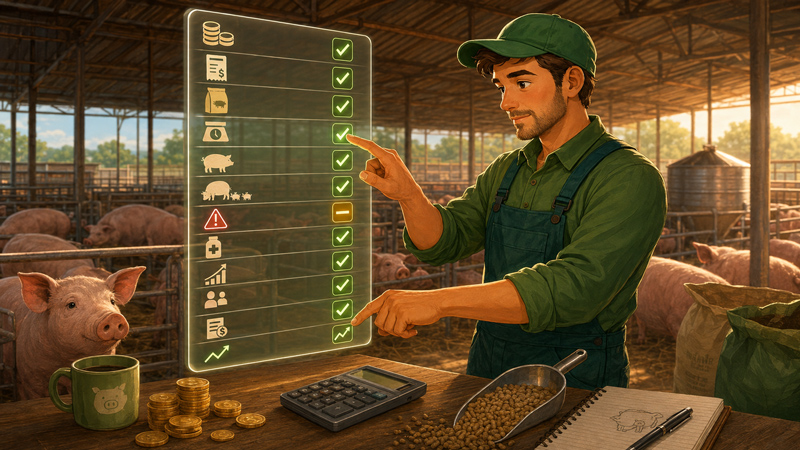

The Monthly Pig-Farm Profitability Checklist
September 01, 2026
 Running a pig farm profitably requires more than checking whether money remains in the bank at the end of the month.
A positive bank balance can create a false sense of security. Some expenses may not have been recorded yet, customers may still owe money, feed may have been purchased but wasted, and animals may have died without the financial loss being calculated.
The opposite can also happen. A farm may appear to have performed poorly during a month in which it purchased a large quantity of feed or made a major investment that will support production for several months.
To understand whether a pig farm is genuinely profitable, farmers need to review production and financial records together.
A monthly profitability review helps answer four essential questions:
- How much did the farm earn?
- How much did it spend?
- What happened to production?
- Did the farm make or lose money?
This checklist explains what pig farmers should review every month and how those records can support better decisions.
1. Record all farm income
Begin by recording every source of income received or earned during the month.
Pig-farm income may come from:
- Sale of market pigs
- Sale of piglets
- Sale of breeding animals
- Sale of culled animals
- Manure sales
- Other farm products or services
For every sale, record the date, customer, number of animals, animal category, total weight where relevant, price and payment status.
Do not treat every sale as cash already available. A customer who has received pigs but has not paid still owes the farm money. Record the sale and the outstanding balance separately.
This distinction helps the farmer understand both revenue and cash flow.
Revenue shows what the farm earned. Cash flow shows what money entered or left the business during the period. A farm can generate sales and still struggle to pay bills when customers pay late.
At the end of the month, calculate:
- Total sales
- Total payments received
- Total outstanding customer balances
- Average selling price per animal
- Average selling price per kilogram, when applicable
Comparing these figures over time can reveal whether sales volume and prices are improving or declining.
2. Record every farm expense
Small expenses are easy to forget, especially when they are paid in cash.
Transport, disinfectants, repairs, casual labour and small medical purchases may appear insignificant individually. Together, they can consume a substantial portion of the farm’s income.
Typical pig-farm expenses include:
- Feed purchases
- Veterinary services
- Medicines and vaccines
- Labour
- Water
- Electricity
- Fuel
- Transport
- Repairs and maintenance
- Cleaning and disinfection
- Breeding costs
- Equipment
- Rent
- Insurance
- Administrative expenses
Every expense should include the date, amount, supplier, payment method and category.
Expense categories are important because a single total does not explain where the money went. Knowing that the farm spent ₦3 million during the month is less useful than knowing how much was spent on feed, labour, veterinary care, transport and repairs.
Consistent categorisation makes it easier to identify which costs are increasing and where intervention is possible.
3. Calculate the true cost of feed
Feed is usually one of the largest costs in pig production. Even a small increase in feed price, waste or inefficient usage can significantly reduce profit.
Do not evaluate feed cost only by looking at how much feed was purchased during the month. Purchases and consumption are not the same.
Some of the purchased feed may remain in inventory at the end of the month. Similarly, feed consumed during the month may include stock purchased earlier.
To estimate feed consumption more accurately, use:
Opening feed inventory + feed purchased − closing feed inventory = feed used
For example, suppose the farm started the month with 1,000 kilograms of feed, purchased another 5,000 kilograms and ended with 800 kilograms.
The estimated feed used would be:
1,000 kg + 5,000 kg − 800 kg = 5,200 kg
The farmer can then compare the feed used with the number and type of pigs on the farm.
Review:
- Feed purchased
- Feed consumed
- Closing feed inventory
- Feed cost per kilogram
- Feed usage by pig group
- Feed waste or unexplained differences
- Supplier price changes
A rising feed bill is not automatically a problem if the farm has more pigs or produces more weight. The important question is whether feed cost increased faster than production.
4. Check feed inventory physically
The quantity shown in the records should be compared with the feed physically available on the farm.
Differences may be caused by:
- Unrecorded feeding
- Spillage
- Spoilage
- Theft
- Incorrect measurements
- Damaged bags
- Delivery shortages
- Data-entry errors
Ignoring inventory differences allows losses to continue unnoticed.
A monthly physical count helps confirm whether the farm’s records reflect reality. When a difference is discovered, record it and investigate the likely cause.
Repeated shortages should not be dismissed as normal. They may indicate a weakness in storage, measurement or staff procedures.
5. Review the number of pigs in every group
A farmer should know how many pigs are present and where they are in the production cycle.
Review the number of:
- Boars
- Breeding sows
- Pregnant sows
- Lactating sows
- Dry sows
- Piglets
- Weaners
- Growers
- Finishers
- Animals ready for sale
- Sick or isolated pigs
The physical count should match the farm records.
If the records show 200 pigs but only 193 can be accounted for, the difference requires investigation. It may reflect deaths, sales, transfers or recording errors that were never entered.
Accurate livestock numbers are necessary for calculating feed needs, mortality rates, treatment costs, available housing and expected future sales.
6. Review births, weaning and reproductive performance
Breeding performance determines the farm’s future production.
A farm can appear busy while producing fewer piglets than necessary. Poor conception rates, small litter sizes, high pre-weaning mortality or long intervals between litters can reduce future revenue.
Each month, review:
- Number of sows served
- Number of confirmed pregnancies
- Number of farrowings
- Total piglets born
- Piglets born alive
- Stillbirths
- Piglets weaned
- Pre-weaning deaths
- Average litter size
- Average number of piglets weaned per litter
- Sows that failed to conceive
- Sows overdue for breeding or farrowing
Do not look only at total births. A high number of piglets born does not guarantee strong production if many die before weaning.
Patterns should be investigated. If several sows have small litters or repeat breeding failures, the farm may need to review boar fertility, sow condition, heat detection, nutrition or breeding management.
7. Calculate mortality and its financial impact
Mortality is not only a production statistic. Every death represents a financial loss.
The loss may include:
- Purchase or breeding value of the animal
- Feed already consumed
- Medication and treatment
- Labour
- Housing and utilities
- Lost future sales
- Lost breeding potential
Record every mortality event with the date, animal or group, age or production stage, suspected cause and estimated financial value.
Calculate mortality separately for piglets, weaners, growers, finishers and breeding animals. A single overall mortality rate can hide a serious problem in one production group.
For example, total mortality may look acceptable while pre-weaning deaths are unusually high.
Review whether deaths are:
- Isolated or recurring
- Concentrated in one pen or group
- Connected to a disease pattern
- Related to feed or water
- Associated with temperature or ventilation
- Occurring after a particular treatment or management change
Fast identification of mortality patterns can prevent further losses.
8. Review veterinary and medication costs
Veterinary expenses should be analysed alongside health events.
A higher veterinary bill may be justified if the farm vaccinated more pigs or managed a temporary disease outbreak. However, repeated treatment for the same condition may indicate that the underlying problem has not been resolved.
Review:
- Veterinary visits
- Medicines purchased
- Vaccinations administered
- Animals treated
- Treatment outcomes
- Repeated illnesses
- Medication inventory
- Expired or wasted medicines
- Withdrawal periods before sale
Medication costs should also be connected to the animals or groups that received treatment. This makes it easier to determine the true cost of raising different groups of pigs.
A farm should not reduce necessary healthcare simply to make monthly expenses appear lower. The goal is to identify preventable illness, ineffective treatments and recurring costs.
9. Review weight gain and production progress
Pig numbers alone do not show whether animals are performing well.
Growers and finishers should be weighed regularly or assessed using a consistent estimation method. Their progress should be compared with their age, feed consumption and target selling weight.
Review:
- Average weight by group
- Weight gained during the month
- Feed used by the group
- Animals growing below expectations
- Time required to reach market weight
- Expected sales dates
Slow growth increases the cost of production. The pigs remain on the farm longer, consume more feed, occupy housing and delay income.
If weight gain is poor, possible causes include feed quality, disease, overcrowding, genetics, water access, environmental conditions or inaccurate feed allocation.
The records identify that a problem exists. Farm observation and professional advice help determine the cause.
10. Review labour costs and productivity
Labour should be evaluated as both a cost and a production resource.
Record:
- Salaries and wages
- Casual labour
- Overtime
- Staff advances
- Benefits
- Outsourced work
- Tasks completed
- Staff shortages or absences
A rising labour cost is not necessarily negative if production has expanded. The useful question is whether labour cost is increasing without a corresponding improvement in output or farm management.
Recurring problems such as unrecorded feeding, late cleaning, missed treatments or incomplete records may indicate unclear responsibilities or inadequate supervision.
The monthly review should identify whether employees have the tools, training and instructions required to work effectively.
11. Check outstanding debts and unpaid bills
Profit and available cash are not the same.
A farm may sell many pigs but remain short of cash because customers have not paid. It may also have unpaid supplier invoices that are not visible in the current bank balance.
Review:
- Customers who owe the farm
- Amount owed by each customer
- Date payment became due
- Suppliers the farm owes
- Loan repayments
- Interest charges
- Staff advances
- Upcoming large payments
Old unpaid balances should be followed up before they become bad debts.
Farmers should also avoid spending money that appears available when it is already needed for feed, wages, loan repayments or other obligations.
12. Calculate the monthly operating result
Once the records are complete, calculate the farm’s basic operating result:
Total farm income − total operating expenses = operating profit or loss
This calculation is useful, but it must be interpreted carefully.
A month with significant feed purchases may appear less profitable even when much of that feed remains in inventory. A month with many pig sales may appear highly profitable even though the animals consumed feed and incurred other costs over several previous months.
For a clearer view, farms should eventually track the cost of producing the animals sold. This may include feed, medication, labour and other expenses incurred throughout their production cycle.
At minimum, review:
- Total income
- Total expenses
- Difference between income and expenses
- Feed cost as a percentage of expenses
- Labour cost as a percentage of expenses
- Veterinary cost as a percentage of expenses
- Outstanding income
- Outstanding liabilities
The purpose is not simply to produce one profit figure. It is to understand what influenced the result.
13. Compare the result with previous months
One month in isolation provides limited insight.
Compare the current month with previous periods to identify trends.
Ask:
- Is revenue increasing or decreasing?
- Are feed costs rising?
- Is mortality improving?
- Are pigs taking longer to reach market weight?
- Is the average selling price changing?
- Are customer debts increasing?
- Are veterinary expenses recurring?
- Is the farm becoming more or less profitable?
Seasonal effects should also be considered. Feed prices, demand, disease risk and market prices may change during the year.
The most useful comparison is not always between two consecutive months. Comparing the same period across different years may reveal a more meaningful pattern.
14. Identify the three most important problems
A monthly review can produce a long list of issues. Trying to address everything at once usually leads to poor execution.
Identify the three problems with the greatest financial or operational impact.
For example:
- Feed usage is higher than expected in the grower unit.
- Pre-weaning mortality increased during the month.
- Several customers have overdue payments.
Each problem should have:
- A responsible person
- A specific action
- A deadline
- A way to measure improvement
“Reduce feed waste” is too vague.
A stronger action would be:
Weigh the feed issued to the grower unit daily for the next four weeks, compare it with the expected allocation and record all unexplained differences.
Specific actions are easier to complete and evaluate.
15. Create a plan for the next month
Finish the review by looking forward.
Estimate:
- Expected farrowings
- Piglets likely to be weaned
- Animals reaching market weight
- Expected sales
- Feed requirements
- Vaccinations and treatments
- Labour needs
- Maintenance work
- Major purchases
- Customer payments
- Supplier obligations
Planning helps the farm prepare for cash shortages before they become emergencies.
If several pigs will reach market weight next month, the farmer can begin contacting buyers. If many sows are expected to farrow, the farm can prepare pens, supplies and staff. If feed prices are rising, purchasing decisions can be made using expected consumption rather than guesswork.
How Pigax supports monthly farm reviews
Pigax helps pig farmers keep important production and financial records in one place.
Farmers can record and review information about:
- Pigs and production groups
- Farrowing and piglets
- Feed plans and feed usage
- Feed inventory
- Mortality
- Farm income
- Farm expenses
- Multiple farms
- Reports
Keeping these records connected makes monthly reviews more practical. Instead of searching through notebooks, receipts and separate spreadsheets, farmers can use recorded information to understand what happened across the farm.
Pigax cannot make management decisions for the farmer. Accurate records and regular review are still required. What the system provides is a clearer foundation for identifying problems and measuring performance.
Profitability comes from consistent control
A profitable pig farm is not created by one good sale or one month with a positive bank balance.
Profitability depends on controlling feed, health, reproduction, mortality, labour, inventory, sales and cash flow over time.
The monthly review does not need to be complicated. It needs to be consistent.
Record what happened. Compare it with what should have happened. Investigate the differences. Assign corrective actions. Review the results again next month.
That discipline turns farm records into better decisions.
Use Pigax to manage your pig-farm records and build a clearer picture of production, costs and profitability.